
Choosing the right cubitainer may seem simple, but for businesses relying on bulk liquid storage and transport, the right choice can impact costs, efficiency, safety, and compliance. Choosing the ideal solution necessitates considerable consideration due to the variety of materials, sizes, and combinations available.
Understand Your Liquid Characteristics
The most important consideration for selecting a cubitainer is knowing what you intend to store or transport. Liquids vary widely in physical and chemical properties, and these properties determine the type of packaging that is both safe and suitable.
Important Liquid Characteristics to Evaluate
- Chemical compatibility: Certain liquids and polymers might react.
- Viscosity: Thick or waxy liquids may require specialized valves or pumps.
- Sensitivity to air or light: Some liquids require barrier films or UV protection.
- Temperature sensitivity: Freezing or high temperatures can affect liner performance.
Liquid Attributes and Cubitainer Requirements
| Liquid Property | Risk/Concern | Cubitainer Feature Needed |
| Reactive/Chemically Aggressive | Material breakdown | Chemically resistant liner (e.g., PE or multilayer) |
| High Viscosity | Slow dispensing | Large spout/valve or pump compatible |
| Air/Light Sensitive | Oxidation or degradation | Barrier film or UV protective material |
| Temperature Fluctuations | Expansion/contraction, brittleness | Flexible material & temperature rated |
👉 Best Practice: Work with your supplier to confirm compatibility charts for your specific liquid. Incorrect liner materials can lead to leaks, contamination, or product loss.
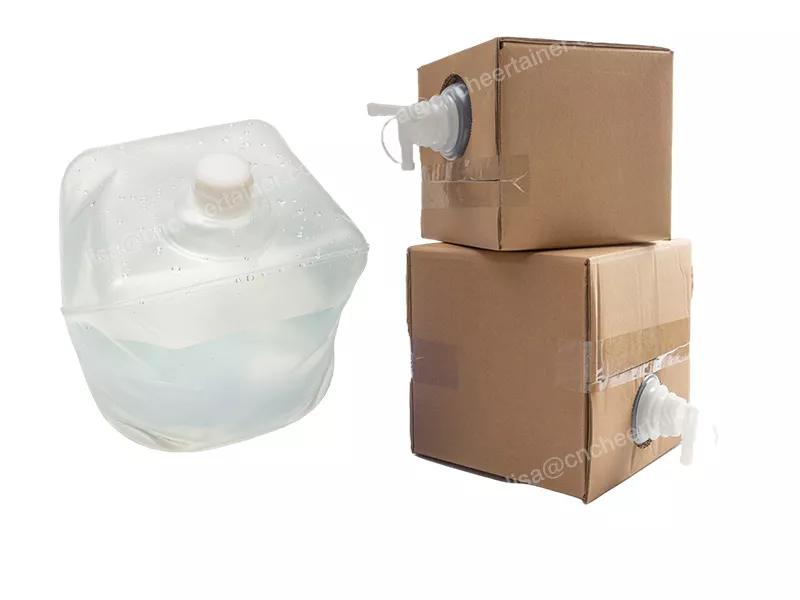
Material Construction and Compatibility
Cubitainers are made from a variety of polymer materials — most commonly polyethylene (PE), laminated films with barrier layers, or engineered plastics designed for specific industrial applications.
Materials Commonly Used
- Low-density polyethylene (LDPE): Flexible and cost effective; good for many chemicals but limited barrier protection.
- High-density polyethylene (HDPE): Stronger and more rigid; better for heavier industrial use.
- Multilayer films: Include barrier layers for oxygen/moisture resistance; ideal for food, pharmaceuticals, or sensitive chemicals.
Material Comparison for Cubitainers
| Material Type | Strength | Barrier Properties | Chemical Resistance | Typical Use Cases |
| LDPE | Moderate | Low | Good | General liquids |
| HDPE | High | Low–Moderate | Very Good | Industrial chemicals |
| Multilayer film | Moderate | High | Very Good | Food, pharma, sensitive chemicals |
Pro Tip: Always ask for manufacturer data sheets (MDS) or compatibility guides before choosing liner materials based on the liquid you’ll handle.
Capacity and Size Options
Cubitainers are available in a wide range of sizes, from small drums of 10–50 liters up to large bulk formats that can hold 500–1000 liters or more. Your choice should balance operational handling, storage constraints, and logistics.
Common Cubitainer Capacities
- 25–100 L: Small batch processing or specialized liquids
- 100–500 L: Medium-sized operations, smaller transport loads
- 500–1000+ L: Large industrial transport, centralized storage
Capacity Selection Guide
| Capacity Range | Best For | Pros | Cons |
| 25–100 L | Small batches, high value liquids | Easy handling, low risk of waste | Frequent refills for large volumes |
| 100–500 L | Mid range operations | Balance of volume and manageability | May still need mechanical handling |
| 500–1000 L+ | Large bulk transport/storage | Fewer containers, lower logistics cost | Requires equipment (pumps/forklifts) |
👉 Example: A business transporting 5,000 liters per week might find 500–1000 L cubitainers more efficient than dozens of smaller units.
Valve and Fitting Configurations
How liquid enters and exits the cubitainer is key to operational efficiency.
Important Valve Features to Consider
- Valve diameter: Larger valves reduce dispensing time.
- Valve type: Ball valves, butterfly valves, or sanitary clamps for food and pharma.
- Adapters and joints: Ensure compatibility with your filling and dispensing equipment.
Valve Type Comparison
| Valve Type | Ideal For | Benefits |
| Small Ball Valve | Low flow liquids | Cost effective, simple operation |
| Large Ball/Bulk Valve | High viscosity or high volume flow | Quick dispensing, less clogging |
| Sanitary Clamp Fitments | Food/Pharma applications | Easy cleaning, high hygiene |
Tip: If your process uses pumps, ensure the cubitainer valve supports smooth pump attachment.
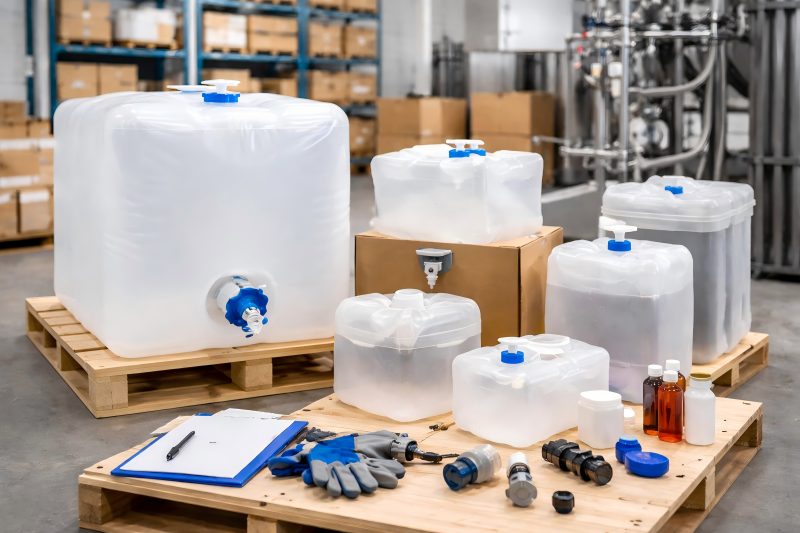
Packaging and Outer Protection
Most cubitainers are used inside a protective carrier such as a cardboard box, wooden crate, or pallet frame. The outer structure provides:
- Physical protection during transport
- Stacking strength
- Ease of forklift handling
- Protection from punctures or tears
Outer Packaging Options
- Single-use cardboard box
- Pallet + wrap
- Rigid crates or cages
- Custom framed pallets
Outer Packaging Options
| Type of Outer Packaging | Protection Level | Cost | Best Use Case |
| Cardboard box | Low–Moderate | Low | Short transport, indoor storage |
| Pallet + wrap | Moderate | Low–Medium | General transport |
| Wooden crate/Frame | High | High | Long distance, rough shipping conditions |
| Metal cage (USD rack) | Very High | Highest | Hazardous goods, heavy duty usage |
Selecting the right outer packaging is just as important as the liner itself, especially for international shipping or rough transport routes.
Regulatory and Compliance Requirements
Different industries (such as food, pharmaceuticals, or hazardous chemicals) are governed by specific safety and compliance regulations.
Regulatory Aspects to Assess
- FDA food-grade certification
- EU EN standards
- ADR / DOT / UN packaging codes for hazardous goods
- BSE/TSE certifications
Compliance Considerations by Industry
| Industry | Key Compliance Needs | Common Requirements |
| Food & Beverage | Sanitary handling, food contact safety | FDA/USDA approved materials |
| Pharmaceuticals | Sterility and purity | USP Class VI materials, GMP documentation |
| Chemicals – Non Hazardous | Standard labeling & safety | OSHA SDS compliance |
| Hazardous Chemicals | Transport legality and safety | UN ADR/DOT approved packaging |
Important: Failing to choose compliant containers can lead to fines, shipment delays, or rejected batches — especially for regulated sectors.
Handling, Storage, and Logistics Impact
While selecting the container is key, you must also consider how it integrates into your existing workflow.
Handling and Logistics Questions
- Will you need forklifts or pallet jacks?
- Can your team handle full cubitainers safely?
- Do you have adequate storage space?
- Does your facility support pump systems or gravity dispensing?
Operational Fit Assessment
| Consideration | Yes/No | Impact on Selection |
| Do we have forklift access? | Yes/No | Needed for larger cubitainers (500–1000 L) |
| Is space limited? | Yes/No | May prefer smaller units |
| Do we need sanitary systems? | Yes/No | Requires specialized valves/fittings |
| Are liquids hazardous? | Yes/No | Must meet UN/DOT regulations |
Assess these internal logistics factors early in the planning process so you don’t end up with cubitainers that cannot be handled efficiently or safely at your site.
Total Cost of Ownership (TCO)
Price per container is only part of the picture. When selecting cubitainers, it’s critical to consider the total cost of ownership, including long term use, replacement, disposal, and efficiency.
Cost Elements to Account For
- Unit purchase price
- Outer packaging cost
- Handling equipment
- Cleaning or disposal
- Regulatory compliance costs (documentation)
- Damage or leakage risk
- Simplified Pricing Factors
- Unit Purchase
- Outer Packaging
- Transport (per liter)
- Regulatory Compliance Admin
- Damage & Leakage Risk
Tip: Always request a full quote that includes liners, outer packaging, delivery, and any specialized fittings or accessories.
Sustainability and Environmental Goals
Today, packaging decisions are increasingly influenced by sustainability goals and environmental policies.
Factors to Evaluate
- Is the liner recyclable or reusable?
- Can the outer packaging be reused?
- Does the solution reduce transportation CO₂ due to higher fill density?
- Are materials produced sustainably?
Environmental Metrics
- Material recyclability
- Reusable liners
- Reduced transportation emissions
- Reduced waste volume
If your business has corporate sustainability goals or must meet environmental reporting criteria, factoring this into your selection process is essential
Choosing the right cubitainer involves evaluating liquid properties, operational needs, regulations, handling capacity, cost, and sustainability. This ensures safer storage, optimized logistics, compliance, and lower long-term costs. You may choose the ideal cubitainer for your company with confidence by evaluating these considerations.