
As sustainability becomes a global priority, the wine industry faces increasing pressure to reduce its environmental footprint. Traditional glass bottles, while iconic, carry a high carbon cost due to their weight, production energy, and transport inefficiency. From manufacturing emissions to post-consumer waste, the glass bottle’s impact stretches across the entire value chain.
To meet growing eco-conscious demands, wineries are embracing innovative packaging alternatives. Among them, the Bag-in-Box (BIB) system stands out as a low-carbon, resource-efficient solution that preserves wine quality while significantly cutting greenhouse gas emissions.
Understanding Carbon Footprint in Wine Packaging
A product’s carbon footprint represents the total greenhouse gases emitted throughout its life — from raw material extraction to manufacturing, transportation, and disposal. In the context of wine, packaging often accounts for more than 40% of total emissions.
Glass bottles are heavy, energy-intensive to produce, and inefficient to transport. By contrast, Bag-in-Box packaging uses lightweight materials and consumes far less energy during production, resulting in a substantial reduction in CO₂ emissions.
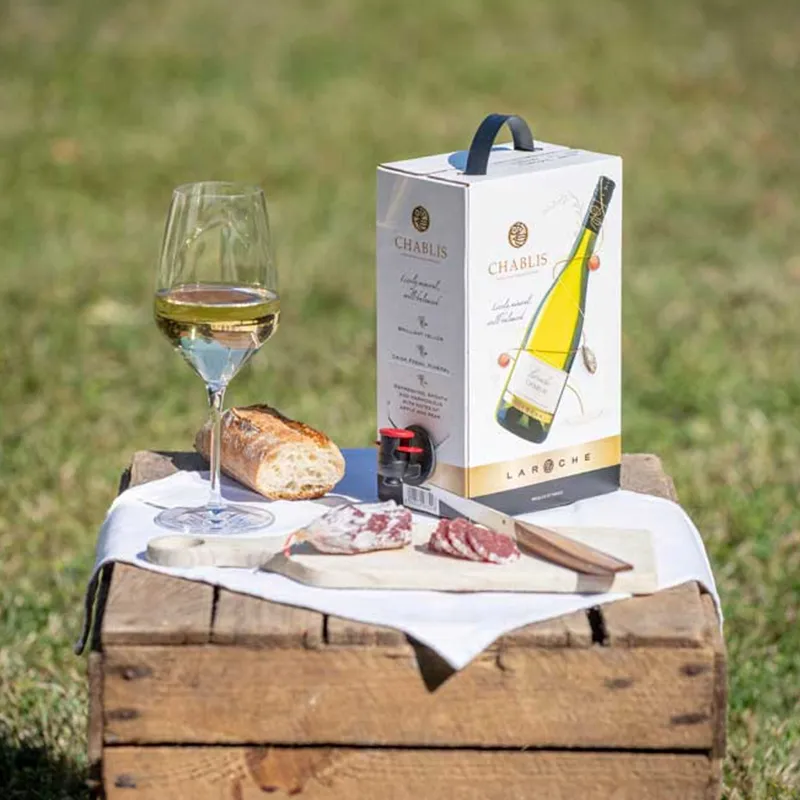
Lifecycle Carbon Emissions (Glass Bottle vs Bag-in-Box)
| Packaging Type | Material Weight | CO₂ Emissions/kg | Transport Energy Use | Recyclability Rate |
| Glass Bottle | ~500 g | 1.2–1.5 kg CO₂ | High | ~60% |
| Bag-in-Box (3 L) | ~50 g | 0.08–0.12 kg CO₂ | Low | 85–90% (with separation) |
These differences translate to up to 80% lower emissions per liter of wine when using Bag-in-Box instead of traditional glass.
Lightweight Design: Reducing Emissions from Transport
Transportation plays a major role in the carbon intensity of wine packaging. Glass bottles add substantial shipping weight — increasing fuel use and emissions.
A 3-liter Bag-in-Box package holds the equivalent of four standard 750 ml bottles, yet weighs 85% less. This lightweight design enables wineries and distributors to ship more product per load, slashing freight emissions and costs.
Shipping Efficiency Comparison
| Packaging | Volume Shipped | Weight Reduction | CO₂ Savings per Pallet |
| Glass Bottles (750 ml × 1000) | 750 L | — | — |
| BIB (3 L × 250) | 750 L | Up to 85% lighter | ~50% less CO₂ |
When scaled across global supply chains, the transport efficiency of Bag-in-Box wine dramatically reduces overall environmental impact — especially for exports.
Material Efficiency: Less Waste, More Recyclability
The Bag-in-Box system consists of two main components:
- An outer cardboard box, made largely from recycled paper.
- An inner flexible bag (usually multilayer polyethylene and EVOH) that maintains wine freshness.
The cardboard is fully recyclable, while the bag’s thin film design uses minimal plastic — around 12–15 g per liter of wine, far less than a PET or glass equivalent. Emerging programs in Europe and North America are improving bag recycling through drop-off schemes and mono-material designs.
Some suppliers are already introducing compostable liners and bio-based plastics derived from sugarcane or corn, further enhancing the sustainability of the BIB system.
Extended Shelf Life and Reduced Wine Waste
Food and beverage waste is another overlooked contributor to global carbon emissions. Once a glass bottle is opened, wine oxidizes quickly and often spoils within days. This leads to unnecessary waste — and wasted energy invested in its production.
The Bag-in-Box format prevents air from entering the wine chamber, allowing the contents to remain fresh for up to six weeks after opening. For consumers, restaurants, and hospitality sectors, this longevity translates into significant waste reduction.
Less wine wasted means less wine produced and transported to replace it — a direct win for both sustainability and profitability.
Energy-Efficient Manufacturing and Lower Resource Use
Producing glass bottles requires temperatures exceeding 1500 °C, consuming vast amounts of natural gas and electricity. Each 750 ml bottle generates roughly 250–300 g of CO₂ before it even leaves the factory.
In contrast, Bag-in-Box manufacturing operates at far lower temperatures and requires less than 10% of the energy used for glass. Water usage is also dramatically reduced, and the amount of raw materials needed per unit of packaging is minimal.
Lifecycle assessments consistently show that Bag-in-Box production emits 4–5 times fewer greenhouse gases than equivalent glass packaging.
End-of-Life: Reuse, Recycling, and Circular Economy Potential
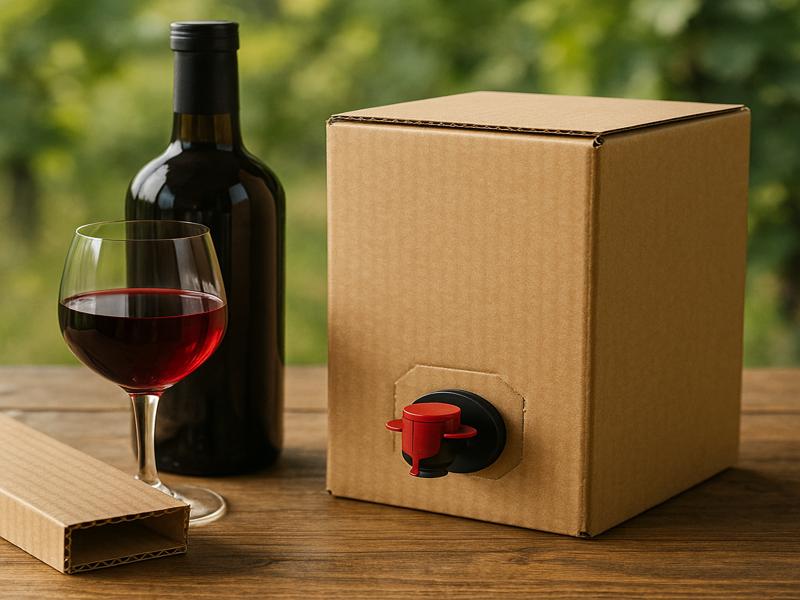
Bag-in-Box packaging for wine aligns well with circular economy goals. The outer box can enter existing paper recycling streams, while the inner bag — once separated — can be sent to specialized soft-plastic facilities.
Some countries have introduced return-collection programs where consumers can drop off used wine bags for recycling or energy recovery. Additionally, certain wineries are exploring refillable BIB systems, where consumers keep the cardboard box and replace only the bag.
Innovations such as mono-layer films (made from 100% polyethylene) are paving the way for easier recycling and full material recovery, closing the loop on BIB packaging sustainability.
Case Studies: Wineries Leading the Eco-Packaging Revolution
French Cooperative Winery (3 L BIB):
After replacing 750 ml bottles with 3 L BIBs for local distribution, the winery reported a 67% reduction in packaging-related CO₂ and 30% lower transport costs.
Australian Brand with Renewable Materials:
Uses 100% recyclable cardboard and partially bio-based film, cutting total carbon emissions by up to 50% compared to glass exports.
U.S. Organic Winery Initiative:
Adopted a refill-ready BIB concept for tasting rooms, eliminating 20,000 glass bottles annually and saving over 10 tons of CO₂ per year.
These success stories demonstrate that eco-friendly packaging can align with both commercial goals and sustainability commitments.
Consumer Perception and Market Acceptance
Historically, Bag-in-Box wine suffered from an image problem — perceived as cheap or lower quality. However, shifting consumer values and packaging design improvements have reshaped that perception.
Today, eco-conscious buyers increasingly view sustainable packaging as a mark of quality and responsibility. Many premium wineries are now launching design-forward BIB formats with elegant graphics and minimalistic branding, proving that luxury and sustainability can coexist.
Retail data shows steady growth in the BIB segment, especially among younger consumers and environmentally aware demographics.
Future Outlook: Innovations in Sustainable Wine Packaging
The evolution of Bag-in-Box packaging is far from over. Research and development continue to focus on improving recyclability, renewable content, and smart features.
Key innovations on the horizon include:
- Bioplastic films derived from renewable sources (PLA, PHA).
- Recyclable mono-material pouches compatible with existing waste streams.
- Refillable BIB systems for direct-to-consumer delivery.
- Smart packaging integration using QR codes to track carbon data and promote transparency.
With these advancements, Bag-in-Box packaging is poised to become a cornerstone of the wine industry’s transition toward a circular, low-emission future.
Bag-in-Box packaging represents more than a convenient format — it’s a tangible pathway toward carbon-neutral wine distribution. By reducing weight, minimizing waste, and embracing recyclability, BIB systems significantly lower greenhouse gas emissions from vineyard to glass.
For wineries, adopting Bag-in-Box packaging not only cuts operational costs but also signals a genuine commitment to environmental stewardship. For consumers, it’s an easy way to enjoy quality wine while supporting a sustainable planet.
As the global wine industry continues to evolve, Bag-in-Box stands as proof that eco-friendly innovation and exceptional taste can indeed pour from the same package.