
Viscous products like syrups, sauces, fruit concentrates, caramel, and dressings have one shared challenge — they don’t like to leave the package. Their sticky, high-viscosity nature means that conventional bag-in-box liners often trap measurable residue in folds and corners. Each drop that clings to the liner becomes waste, increasing cost, cleaning labor, and environmental impact.
The Cheertainer Bag-in-Box system solves this long-standing problem through a design innovation that’s often overlooked: geometry. By using a form-fit, box-shaped liner rather than a loose pillow, the Cheertainer bag eliminates dead zones, stabilizes flow, and ensures nearly complete evacuation of thick products. This article explains, in both engineering and practical terms, how geometry alone can drastically reduce residue in syrups and sauces.
Why Residue Happens in Viscous Liquids
To understand how geometry matters, we first need to look at how viscous materials behave.
The viscosity of most syrups and sauces varies under stress because they are non-Newtonian fluids. Two properties dominate:
| Rheological Property | Effect on Flow | Residue Impact |
| Yield Stress | Fluid will not flow until a minimum pressure or shear is applied | Material remains static in folds or corners |
| Shear-Thinning | Viscosity decreases with movement | Flow stops quickly once pressure drops, leaving streaks |
| Thixotropy | Viscosity rebuilds over time at rest | Fluid “sets” if not continuously agitated |
| Surface Adhesion | High wetting tendency on plastic film | Syrups cling strongly to the bag walls |
In simple terms, every uneven surface, crease, or air pocket creates a zone of low shear. That’s where syrup gets stuck — and that’s where the Cheertainer’s geometry makes all the difference.
From Pillow to Form-Fit: A Shift in Design Philosophy
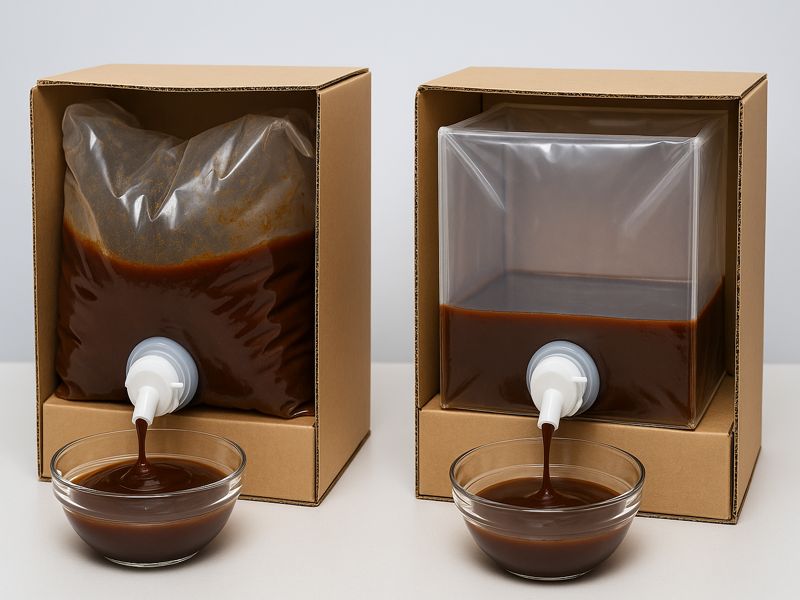
Traditional bag-in-box liners resemble balloons. When filled, they bulge against the box, forming unpredictable folds. When emptied, they collapse irregularly, trapping thick product inside corners.
The Cheertainer Bag replaces that guesswork with a form-fit design that matches the box’s interior dimensions. The result is a liner that behaves like a structural component rather than a flexible sack.
| Feature | Pillow Liner | Cheertainer Form-Fit Liner |
| Shape during fill | Round or irregular | Square, box-conforming |
| Collapse pattern | Random folds | Controlled, predictable |
| Corner formation | Gaps and voids | True box corners |
| Air retention | High | Minimal |
| Residue level | Higher (uneven drain) | Significantly reduced |
Each panel of the Cheertainer bag is pre-creased to collapse inward as the liquid drains. The outlet is strategically aligned with the natural low point, ensuring every milliliter of product flows toward the fitment.
How Geometry Controls Flow
A. Flat Panels Create Drainage Lanes
The Cheertainer bag features flat vertical and bottom panels that guide liquid flow along consistent channels. During emptying, these flat walls act like built-in gutters, minimizing turbulence and directing viscous fluids smoothly to the outlet. Traditional pillow liners, in contrast, generate S-shaped folds that trap fluid in stagnant zones.
B. Corner and Crease Control
Each corner seam of the Cheertainer bag is designed to fold inward, not outward. This geometry behaves like a squeegee: as the walls collapse, the corners push remaining product toward the center. This reduces the “corner puddles” that typically form with sticky syrups and caramelized sauces.
C. Outlet Position and Low Point Alignment
Unlike pillow liners, where the outlet may float or shift, the Cheertainer’s fitment is positioned at the bag’s absolute hydraulic low point. That ensures that, as gravity or pressure assists flow, no fluid remains trapped below the valve level.
D. Stable Head Pressure
The form-fit structure prevents sudden bag deformation. A consistent shape maintains stable hydrostatic head pressure throughout dispensing. This steady force helps overcome yield stress in viscous fluids, keeping flow continuous and reducing start-stop sputtering.
Rheological Science: Why Syrups Behave Better in a Cheertainer Bag
Syrups and sauces exhibit complex flow behavior — but the principle is simple: keep shear high, and they’ll keep moving.
Inside a conventional bag, folds create low-shear zones where flow velocity approaches zero. The syrup then “locks” in place, and gravity alone cannot restart movement. The Cheertainer’s square geometry eliminates these zones, maintaining a uniform flow path and higher shear rates across surfaces.
From a fluid mechanics perspective:
- Lower Bingham Number: The bag’s flat surfaces reduce resistance at low shear rates, lowering the Bingham number (ratio of yield stress to viscous stress) and promoting steady motion.
- Higher Capillary Number: Smooth panels minimize capillary retention forces, allowing syrup films to slide off walls instead of sticking.
In other words, Cheertainer’s geometry keeps the fluid in its “moving state,” while pillow liners push it back into a “solid-like” rest state.
Flow Performance in Different Dispensing Modes
Cheertainer’s advantages hold true across multiple dispensing methods:
| Dispensing Mode | Common Problem | Cheertainer Advantage |
| Gravity Tap | Final 10% of product stalls require tilting | Stable head pressure drains to the outlet naturally |
| Pump-Assist or Air-Assist | Uneven bag expansion traps pockets | Form-fit resists ballooning, drives flow evenly |
| Inline Kitchen Draws | Low flow rates create high residue | Consistent geometry maintains continuous flow |
| Industrial Filler Applications | Variable pressure during dispense | Predictable collapse ensures uniform evacuation |
Across these use cases, operators report cleaner walls, faster last-portion dispense, and lower downtime for rinsing or changeover.
Quantifiable Results: Measurable Reductions in Product Waste
Residue reduction may sound minor — until you multiply it by daily throughput.
Example Calculation
| Parameter | Traditional Pillow Liner | Cheertainer Form-Fit Liner |
| Bag size | 20 L | 20 L |
| Average residue (%) | 1.2% | 0.3% |
| Product density | 1.3 kg/L | 1.3 kg/L |
| Residue weight | 0.312 kg | 0.078 kg |
| Daily bags used | 100 | 100 |
| Total daily waste saved | — | 23.4 kg |
That’s over 23 kilograms of syrup saved per day — or more than 8 tons per year, depending on the operation’s scale. In high-value products like chocolate syrup or fruit concentrate, those savings directly translate into higher margins.
Operational and Economic Advantages
A. Reduced Cleaning and Maintenance
Less residue means fewer rinses and shorter cleaning cycles. In production environments where hot water or cleaning agents are used, this directly cuts water, energy, and chemical consumption.
B. Faster Changeovers
Operators no longer spend time tilting boxes or scraping liners. The clean-drain geometry allows quick removal and refill, improving overall equipment effectiveness (OEE).
C. Improved Product Consistency
Because product evacuation is complete, each batch dispensed or blended maintains a consistent composition. No more variation from the “first pour” versus “last pour.”
Design Synergy: Geometry Meets Material Science
While the geometry defines how the bag empties, the film structure determines how easily the product detaches. Cheertainer liners are usually made from multilayer co-extrusions combining:
- Inner layer (low surface energy): Promotes slip and clean release for sticky liquids.
- Barrier layer: Maintains flavor and aroma integrity.
- Outer layer: Provides mechanical strength and sealing performance.
The synergy between form-fit shape and low-adhesion film ensures syrup sheets cleanly off the wall without forming dry patches or streaks.
Application Examples
- Chocolate and Caramel Syrups: Reduced sugar crystallization on bag walls, faster dispensing.
- Ketchup and Tomato Paste: Even collapse prevents corner build-up, easier final evacuation easier.
- Fruit Concentrates and Smoothies: Smooth internal surfaces keep pulp from settling.
- Savory Sauces and Marinades: Predictable drainage supports portion accuracy in kitchen dispensers.
In all cases, residue levels are visibly lower, and box interiors remain remarkably clean.
Implementation Tips for Best Results
To maximize the benefits of Cheertainer geometry, a few operational guidelines help:
- Use the correct box size. The bag’s form-fit shape depends on tight box conformity; avoid oversize cartons that reintroduce folds.
- Align the fitment downward. Ensure the outlet remains the lowest point during dispensing.
- Tilt slightly for final evacuation. A 5–15° forward tilt enhances gravity flow.
- Select the valve bore appropriately. For thick sauces, a larger outlet diameter maintains shear and prevents blockage.
- Train operators. Teach staff to finish with a gentle “sweep squeeze” that aligns with the bag’s collapse pattern.
Following these steps can push product recovery rates beyond 99.5% for most viscous applications.
Sustainability and Hygiene Impact
The environmental implications of geometry are surprisingly large:
- Less product waste: Every kilogram of saved syrup reduces upstream agricultural, processing, and shipping emissions.
- Less rinse water: Cleaner evacuation cuts wash cycles by up to 30%.
- Cleaner disposal: Nearly empty liners reduce organic load in waste streams, improving recyclability.
- Better hygiene: No stagnant pockets mean fewer microbial risks in partial-use foodservice environments.
By addressing waste at the packaging stage, the Cheertainer design contributes directly to circular-economy goals in food and beverage operations.
Case Snapshot: Sauce Manufacturer’s Yield Improvement
A European sauce processor handling 1,000 L per day of barbecue and ketchup blends conducted side-by-side testing.
| Metric | Before (Pillow Liner) | After (Cheertainer) | Improvement |
| Average residue per 20 L bag | 240 g | 50 g | −79% |
| Cleaning water used per shift | 120 L | 80 L | −33% |
| Time per changeover | 7 min | 4 min | −43% |
| Annual product savings | — | ~4.5 tons | Significant ROI |
The switch not only reduced waste but also simplified operations and sanitation compliance audits.
The Geometry–Performance Connection
What makes the Cheertainer concept powerful is its simplicity. No moving parts, no pumps, no complex mechanisms — just better geometry. When the internal shape matches the product’s flow behavior, the liquid cooperates instead of resisting. Corners collapse in the right direction; panels guide flow instead of trapping it.
The result:
- Up to 80% reduction in product residue
- Faster dispensing and cleaner operations
- Direct cost and sustainability benefits
For years, packaging design has focused on materials, barriers, and valves, often neglecting something fundamental: shape. The Cheertainer Bag-in-Box liner proves that geometry alone can unlock major performance gains for viscous products. By conforming perfectly to the carton, folding predictably, and aligning with fluid mechanics, it minimizes waste and maximizes yield.
In applications like syrups and sauces — where every drop counts — this design innovation turns packaging into a process tool. Less waste, cleaner dispensing, lower costs: proof that sometimes, the smartest engineering solution is simply the right shape.